- HIPAA Insider
- Posts
- Ghosted After Your HIPAA Questionnaire?
Ghosted After Your HIPAA Questionnaire?
The real reason enterprise buyers stop replying.

HIPAA Insider
March 04, 2026
What Healthcare Buyers Really Look For in Security Reviews by HIPAA Vault
You signed the BAA.
You filled out the spreadsheet.
You checked every box.
So why did the health system go silent?
Because a HIPAA security questionnaire isn’t about perfect answers — it’s about proof.
As cybersecurity expert Larry Trotter II said on the HIPAA Insider Show:
“If I see everything and it’s 100%, that raises a flag for me — because no one’s 100%.”
Enterprise buyers don’t audit your optimism. They audit your maturity.
They look for:
A documented, updated risk assessment
Continuous monitoring — not just alerts
Policies that match your actual infrastructure
Security embedded into your SDLC
AI security controls (not just AI governance)
If those don’t line up, trust disappears — and so does the deal.
At HIPAA Vault, we help healthcare startups build infrastructure that stands up to real scrutiny:
Hardened HIPAA-compliant hosting
Managed safeguards
Continuous monitoring
Audit-ready environments
So when the next questionnaire lands in your inbox, you answer with confidence — not hope.
Want to know what buyers are actually flagging?
We’ll walk through your current setup and show you exactly where enterprise reviewers will push back.
No pressure. Just clarity.
Because in healthcare, confidence closes deals — not checkboxes.
Catch the full conversation with Larry Trotter II on the HIPAA Insider Show:
▶ Watch on YouTube
🎧 Listen on Spotify
Quote of the Week
“Compliance on paper is easy. Operational security is earned.” — Larry Trotter II
Industry News Roundup
Healthcare Breaches Cool Off — But Don’t Celebrate Yet
January brought a slight breather in healthcare cyber chaos.
Large breaches (500+ records) dropped 13% month over month to 46 incidents. Even more surprising? Only 1.44 million individuals were affected — well below the 12-month average of 5.1 million.
Zoom out and the trend looks promising:
Monthly breach averages have fallen sharply since September.
Victim counts dropped 85% compared to mid-2025 levels.
This was the lowest January total since 2020.
But before anyone pops champagne…
Two massive 2025 breaches (Trizetto and Conduent) still aren’t fully reflected in federal totals — and could rank among the largest ever recorded.
January’s biggest hits?
State agencies in Illinois (705K) and Minnesota (303K) — both tied to internal access failures.
The takeaway: Ransomware still dominates incident volume, but access missteps are driving the biggest damage.
→ Want the full breakdown — including enforcement penalties and state-by-state data?
Dive into the complete January 2026 Healthcare Data Breach Report.
Medical Device Maker Discloses Cyberattack
Another public healthcare company just filed an 8-K.
UFP Technologies — a $600M medical device manufacturer supplying wound care, implants, and surgical products — confirmed it suffered an IT intrusion detected February 14.
The good news:
Systems have been restored.
Operations continued “in all material respects.”
Cyber insurance is expected to cover a significant portion of costs.
The not-so-good news:
Data was stolen.
The company confirmed some information was exfiltrated, though it’s still unclear whether personal or protected health information was involved. Billing and labeling systems were among those impacted — a reminder that operational tech is just as critical as EHR systems.
No threat group has claimed responsibility (yet), but the combination of data theft and system disruption points toward ransomware or wiper-style malware.
Why it matters: Even when operations resume quickly, SEC disclosure requirements mean cyber risk is now investor risk.
→ Read the full breakdown here.
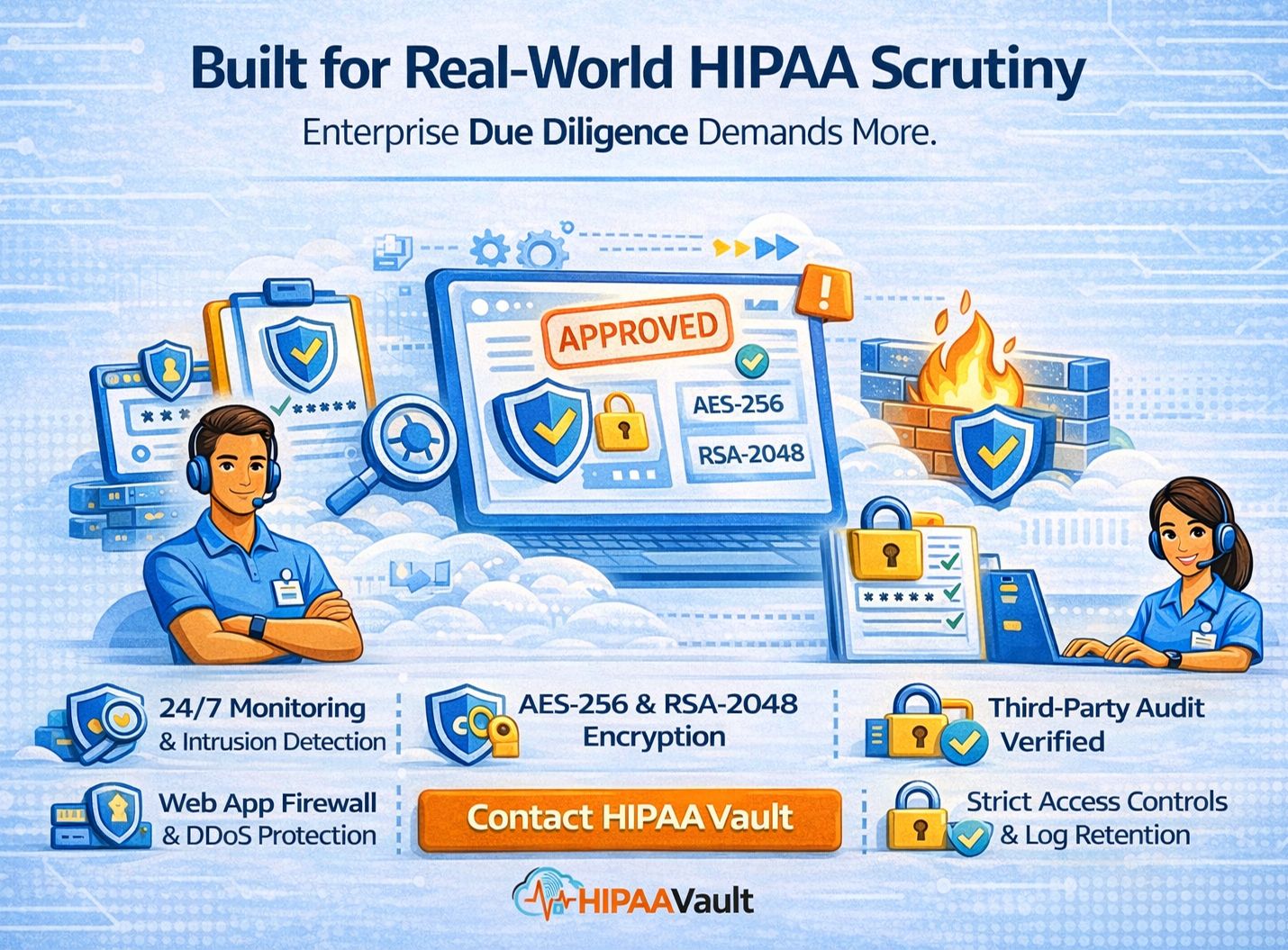
Built for Real-World HIPAA Scrutiny
Security headlines are one thing.
Security questionnaires are another.
If enterprise buyers are asking tougher questions in 2026, your infrastructure needs to answer them — automatically.
At HIPAA Vault, we don’t just offer hosting.
We deliver operational HIPAA maturity.
That means:
24/7 monitored infrastructure with SIEM + log management
AES-256 encryption at rest, RSA-2048 in transit
Web Application Firewall + Host Intrusion Detection
Managed firewall rules and intrusion prevention
Vulnerability scanning + server hardening
Onsite & offsite backups with BC/DR planning
Bootless kernel updates to reduce patching risk
Multi-tenant isolation and DDoS protection
Enforced 2FA and strict access controls
A signed Business Associate Agreement
6-year log retention policies
We’re third-party audited and verified by the Compliancy Group — so your buyers don’t have to “take your word for it.”
Because in today’s healthcare market, compliance isn’t a checkbox.
It’s a competitive advantage.
→ Want infrastructure that stands up to enterprise due diligence?
Contact HIPAA Vault and see what audit-ready actually looks like.