- HIPAA Insider
- Posts
- AI built it fast. Secured later?
AI built it fast. Secured later?
That mindset is putting healthcare apps—and patient data—at risk.

HIPAA Insider
April 15, 2026
AI healthcare apps are booming, but compliance is playing catch-up by HIPAA Vault
AI is making it dramatically easier for clinicians and founders to build healthcare apps in days instead of months. The catch: a working app is not the same as a HIPAA-compliant one.
Many of these AI-generated tools aren’t built with security in mind, which can create problems like:
exposed patient data
weak authentication
poor API handling
missing audit logs
hidden vulnerabilities
And HIPAA doesn’t care if your app simply functions. It requires that patient data is protected at all times. That means teams need:
secure infrastructure
secure application code
strong access controls
encryption
ongoing risk analysis and monitoring
AI is speeding up healthcare innovation, but it is also speeding up the risks that come with shipping too fast. The teams that stand out won’t just be the ones that launch quickly—they’ll be the ones that build trust into the product from day one.
🎥🎧 See it in action or hear the breakdown—watch on YouTube or listen on Spotify.
Quote of the week
“AI can build your product fast—but it won’t protect your users. That part is still on you.”
→ Building with AI, launching fast, or testing your healthcare app? Make sure compliance isn’t an afterthought. Secure it before it scales.
Industry News Roundup
Healthcare’s data breach problem just got worse
Healthcare organizations had a February they’d very much like to erase from the records. A total of 63 major data breaches were reported, exposing the protected health information of more than 8.1 million individuals—a jaw-dropping 436% increase compared to January and well above the monthly average.
The heavy hitters
A pair of mega breaches drove much of the damage:
TriZetto Provider Solutions suffered a prolonged intrusion, with hackers accessing systems for nearly a year and compromising 3.4 million records
QualDerm Partners saw over 3.1 million individuals impacted in a rapid data theft incident
Together, these two incidents alone accounted for the majority of February’s total exposure.
Fewer breaches, bigger consequences
Here’s the twist: while the number of breaches is actually down 10.6% year-over-year, the number of individuals affected has surged 44.7%. In other words, attacks are becoming more efficient—and more devastating.
What’s driving it
Hacking continues to dominate, responsible for 98.6% of affected individuals. Many of these attacks targeted network servers and third-party vendors, highlighting a persistent weak spot: business associates. When they get hit, the ripple effects spread across dozens of healthcare providers.
The healthcare sector isn’t necessarily getting attacked more often—but when it does, the fallout is hitting harder than ever.
→ Read the full breakdown—because 8 million exposed records deserve more than a headline.
Six new breaches, same healthcare problem
TCybercriminals had a banner year—and everyone else paid for it. In 2025, reported losses from cybercrime hit nearly $21 billion, a 26% jump from 2024, according to the FBI. Even more telling: complaints topped 1 million for the first time ever, or roughly 3,000 per day.
Where the money went
Not all scams are created equal:
Investment fraud led the pack with a massive $8.6B in losses
Business email compromise (BEC) followed at $3B
Tech support scams weren’t far behind at $2.1B
Meanwhile, phishing remained the most common complaint, proving that the simplest tricks still work best.
The new frontiers
Crypto and AI are joining the party—fast. Crypto-related scams drove billions in losses, while AI-linked incidents racked up nearly $900 million.
Healthcare remains the top target among critical infrastructure sectors, and ransomware groups are getting more organized—and more effective.
→ $20 billion lost—and counting. Read the full breakdown.
Secure it before it scales
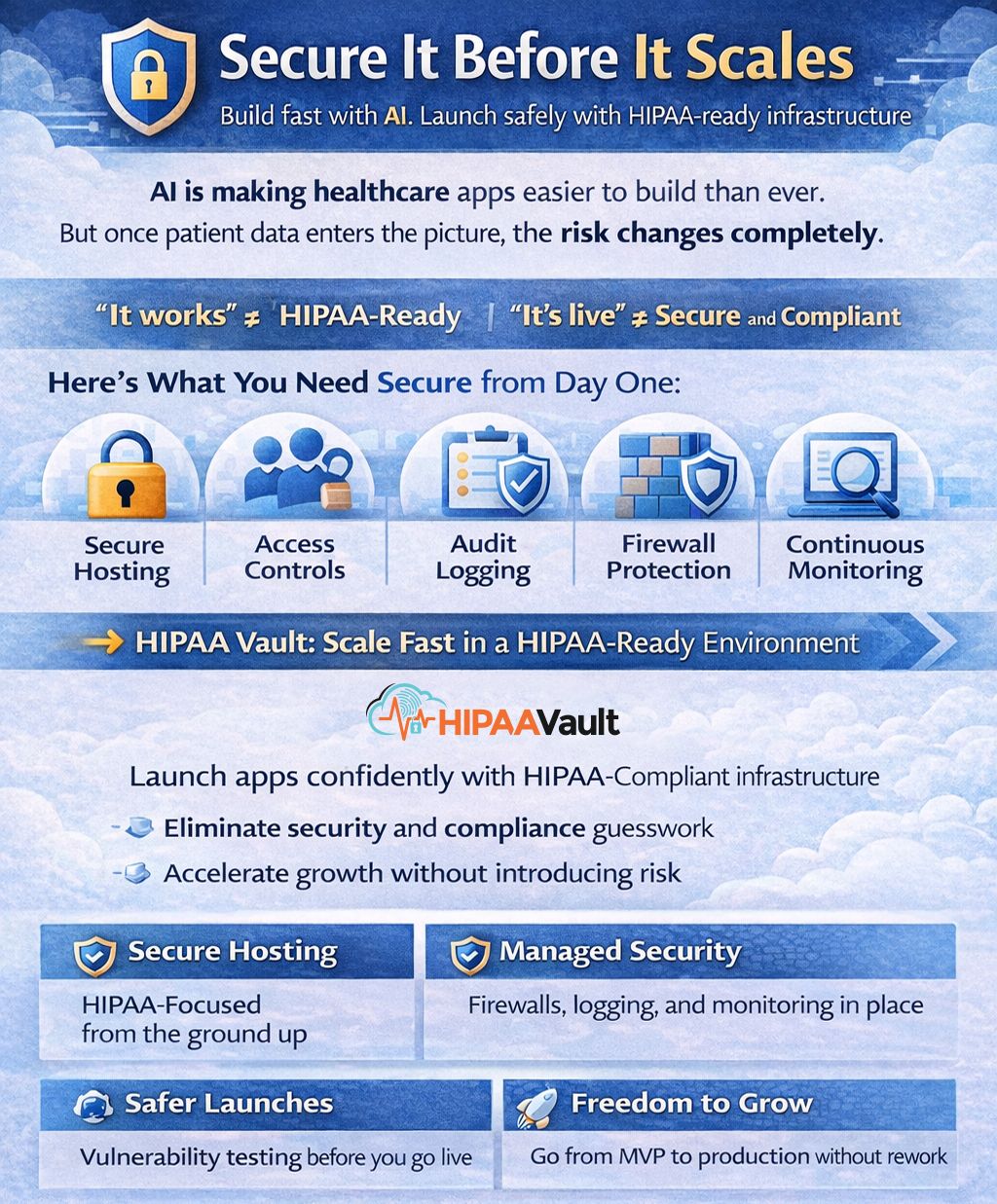
AI is making healthcare apps easier to build than ever—but as we just saw, the real risk begins when those apps start handling patient data.
Because “it works” doesn’t mean “it’s secure.” And it definitely doesn’t mean “it’s HIPAA-compliant.”
Once ePHI enters the picture, things change fast. Hosting, access controls, logging, firewall protection, and continuous monitoring all become part of the equation—not after launch, but before it.
That’s where HIPAA Vault comes in. It helps healthcare teams deploy apps in secure, managed environments designed for HIPAA-sensitive workloads—so you can move fast without creating risk.
With HIPAA Vault, teams can:
host healthcare apps in a HIPAA-focused environment
strengthen security with managed firewalls and logging
support safer launches with vulnerability testing
reduce infrastructure and compliance guesswork
move from MVP to production with more confidence
→ Building with AI or preparing to launch? Secure it before it scales.